Cyber Security Consultant: Strengthening Business Security in a Digital World

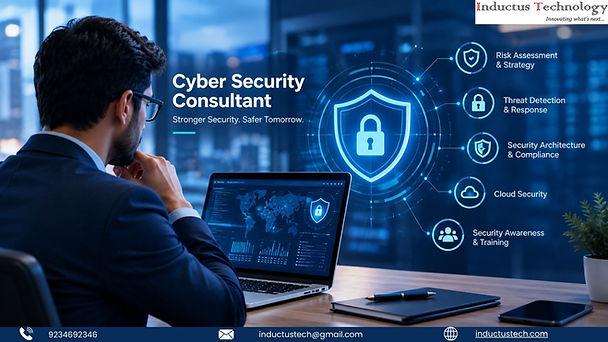
As businesses become increasingly dependent on cloud platforms, enterprise applications, connected devices, remote access, and digital data, cybersecurity has become an essential part of business operations. A cyber security consultant helps organizations identify vulnerabilities, manage cyber risks, strengthen security controls, and develop strategies to protect critical systems and information.
Rather than responding only after a security incident occurs, cybersecurity consulting enables businesses to take a proactive approach. By assessing infrastructure, applications, users, processes, and security controls, consultants can help organizations create a security strategy aligned with their operational requirements.
What Is a Cyber Security Consultant?
A cyber security consultant is a cybersecurity professional who evaluates an organization's digital environment and provides recommendations or implementation support to reduce security risks.
A consultant may work across areas such as network security, cloud security, endpoint protection, identity and access management, vulnerability management, security monitoring, compliance, and incident response.
The objective is not simply to deploy more security tools. Effective cybersecurity consulting focuses on understanding business risks and implementing security
measures that protect important assets while supporting business continuity.
Why Do Businesses Need Cyber Security Consulting?
Cyber threats continue to evolve as organizations adopt new technologies and digital business models. Phishing, ransomware, credential theft, malware, unauthorized access, application vulnerabilities, and cloud misconfigurations can affect businesses of different sizes and industries.
At the same time, organizations often operate complex technology environments involving cloud services, legacy infrastructure, third-party applications, remote employees, and connected devices.
A cyber security consultant can help businesses answer important questions such as:
Which systems are most exposed to cyber threats?
Where are the organization's most significant vulnerabilities?
Are users and applications properly protected?
Is sensitive business data adequately secured?
Are cloud environments configured securely?
Can the organization detect suspicious activity quickly?
How prepared is the business to respond to a security incident?
Are existing security controls aligned with business requirements?
Key Cyber Security Consulting Services
1. Cybersecurity Risk Assessment
A cybersecurity risk assessment provides a structured view of an organization's security posture. Consultants examine infrastructure, applications, endpoints, access controls, policies, data, and processes to identify vulnerabilities and potential risks.
The results can be prioritized according to business impact, helping organizations focus resources on the most important security gaps.
2. Vulnerability Assessment
Vulnerability assessments identify weaknesses in systems, applications, networks, and devices that could potentially be exploited.
Regular assessments can help businesses discover outdated software, insecure configurations, exposed services, weak controls, and other vulnerabilities before they become larger security problems.
3. Penetration Testing
Penetration testing uses controlled security testing to evaluate whether identified vulnerabilities can be exploited.
Testing can provide organizations with a better understanding of their actual exposure and help security teams prioritize remediation.
4. Network Security Consulting
A consultant can review network architecture, segmentation, firewalls, remote access, traffic controls, and other security mechanisms.
Modern network security strategies may also need to account for cloud environments, remote workers, connected devices, and distributed applications.
5. Cloud Security
Cloud adoption has transformed how organizations store data and operate applications. However, cloud environments also introduce configuration, identity, access, and data-protection considerations.
Cybersecurity consultants can assess cloud configurations, identity permissions, workloads, storage, APIs, and security monitoring to help organizations establish stronger cloud security practices.
6. Identity and Access Management
Compromised credentials can provide attackers with access to sensitive systems and information. Cybersecurity consulting can help organizations strengthen authentication, authorization, privileged access, user permissions, and identity lifecycle management.
Multi-factor authentication and least-privilege access are examples of controls that can contribute to stronger identity security when appropriately implemented.
7. Endpoint Security
Laptops, desktops, mobile devices, servers, and other endpoints can become entry points for cyber threats.
Consultants can review endpoint protection, patching, device configurations, application controls, and monitoring capabilities to help organizations improve endpoint security.
8. Security Monitoring and Threat Detection
Security monitoring helps organizations identify suspicious activity and potential attacks. Consultants can assist with establishing appropriate monitoring processes, alerting mechanisms, logging, and incident escalation procedures.
Effective monitoring can improve an organization's ability to detect and respond to security events.
9. Incident Response Planning
Even strong security controls cannot guarantee that an organization will never experience a security incident.
A cyber security consultant can help businesses develop incident response plans covering detection, containment, investigation, communication, recovery, and post-incident improvement.
10. Compliance and Security Governance
Organizations may need to meet industry-specific, contractual, or regulatory security requirements.
Cybersecurity consultants can help review existing policies and controls, identify gaps, establish governance processes, and prepare documentation required for security and compliance programs.
Benefits of Working With a Cyber Security Consultant
Hiring a cybersecurity consultant can provide organizations with several practical benefits.
Improved Visibility
An independent assessment can help organizations understand their current security posture and identify gaps that may not be obvious during routine IT operations.
Proactive Risk Management
Instead of waiting for a security incident, businesses can identify and address vulnerabilities before they create larger operational problems.
Access to Specialized Expertise
Cybersecurity encompasses many technical areas. Consulting provides access to specialized knowledge without requiring every organization to maintain expertise in every security discipline internally.
Better Security Investment Decisions
A structured risk assessment can help organizations prioritize security spending based on business requirements rather than purchasing technologies without a defined strategy.
Stronger Incident Preparedness
Incident response planning can help employees and security teams understand their responsibilities when a security event occurs.
Support for Digital Transformation
Businesses can incorporate security considerations into cloud adoption, application modernization, automation, remote work, and other digital initiatives.
Cyber Security Consultant vs. IT Support
IT support and cybersecurity consulting serve different but complementary purposes.
IT support generally focuses on maintaining systems, resolving technical issues, managing devices, and keeping business technology operational.
A cyber security consultant focuses specifically on identifying and reducing security risks. This can involve evaluating whether systems are vulnerable to unauthorized access, whether sensitive data is adequately protected, whether security controls are effective, and whether the organization can respond appropriately to incidents.
For many businesses, combining reliable IT operations with a structured cybersecurity strategy provides a more comprehensive approach to technology management.
How to Choose a Cyber Security Consultant
Businesses should consider several factors when selecting a cybersecurity consulting partner:
Technical expertise: Evaluate experience across network, cloud, endpoint, application, identity, and data security.
Industry experience: Look for familiarity with the risks and requirements relevant to your sector.
Assessment methodology: Understand how vulnerabilities and risks will be identified and prioritized.
Security frameworks: Consider experience with relevant cybersecurity frameworks and standards.
Implementation support: Determine whether the consultant can help implement recommended improvements.
Incident response expertise: Review capabilities for incident preparedness and response.
Scalability: Ensure the approach can evolve as your business and technology environment grow.
Clear reporting: Security findings should be communicated in terms that both technical teams and business leaders can understand.
Ongoing support: Cybersecurity requires continuous improvement rather than a one-time assessment.
Building a Proactive Cybersecurity Strategy
Cybersecurity should be integrated into business planning rather than treated as a separate technical activity.
Organizations can begin by identifying critical systems and data, assessing current risks, reviewing access controls, testing vulnerabilities, improving monitoring, and establishing incident response procedures.
As businesses adopt cloud services, automation, AI, connected technologies, and remote operations, cybersecurity strategies should evolve alongside those technologies.
A cyber security consultant can provide the expertise needed to assess the current environment, identify priorities, and develop a practical roadmap for improving security.
Cyber Security Consulting for Modern Businesses
A strong cybersecurity strategy requires more than individual security products. Organizations need a combination of technology, processes, policies, employee awareness, monitoring, and response capabilities.
Inductus Technologies provides cyber security services designed to help organizations strengthen their security posture and address evolving digital risks. Businesses can explore the Cyber Security services to learn more about available cybersecurity solutions.
Frequently Asked Questions
What does a cyber security consultant do?
A cyber security consultant evaluates an organization's technology environment, identifies security risks and vulnerabilities, recommends improvements, and may assist with implementing security controls, compliance programs, and incident response processes.
Why is cybersecurity consulting important?
Cybersecurity consulting provides specialized expertise that can help businesses identify security gaps, prioritize risks, strengthen controls, and prepare for potential security incidents.
What services does a cyber security consultant provide?
Services can include risk assessments, vulnerability assessments, penetration testing, network security, cloud security, identity management, endpoint security, security monitoring, incident response planning, compliance, and security strategy.
Conclusion
Cybersecurity is now an important consideration for every organization operating in a connected digital environment. From cloud applications and remote access to business data and connected infrastructure, multiple technology layers require appropriate protection.
A cyber security consultant can help organizations identify vulnerabilities, assess risks, strengthen security controls, prepare for incidents, and develop a long-term cybersecurity strategy.
With a proactive and risk-based approach, businesses can improve their security posture while continuing to adopt new technologies and pursue digital growth.


Comments