Application Modernization Services: Transforming Legacy Systems for the Digital Future
- Inductus Tech
- Jul 14
- 4 min read

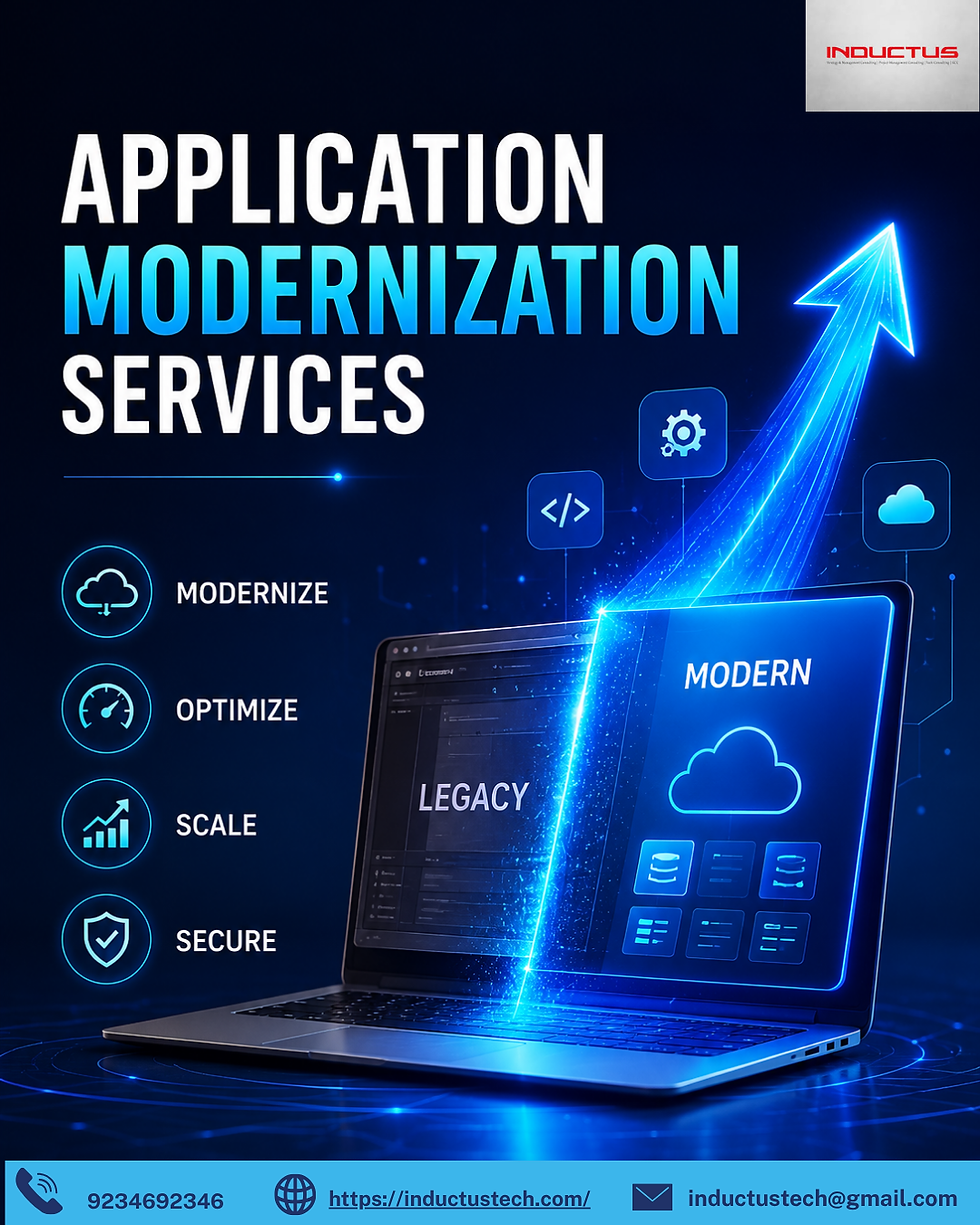
As businesses embrace digital transformation, many continue to rely on legacy applications that are costly to maintain, difficult to scale, and incompatible with modern technologies. These outdated systems can slow innovation, increase operational risks, and limit business agility. Application modernization services help organizations overcome these challenges by upgrading legacy applications into secure, scalable, and cloud-ready solutions.
Application modernization enables businesses to improve performance, reduce maintenance costs, integrate emerging technologies, and deliver better user experiences. It is a critical step for organizations looking to remain competitive in today's fast-changing digital landscape.
What Are Application Modernization Services?
Application modernization services involve updating, reengineering, or replacing legacy applications using modern technologies, cloud platforms, and software architectures. The objective is to enhance application performance, security, scalability, and maintainability without disrupting business operations.
These services typically include:
Legacy application assessment
Cloud migration
Application reengineering
API integration
Microservices architecture
UI/UX modernization
Database modernization
Ongoing optimization and support
Modernized applications are better equipped to support business growth and innovation.
Why Businesses Need Application Modernization
Legacy applications often become barriers to digital transformation. They may lack integration capabilities, require expensive maintenance, and struggle to meet evolving business requirements.
Application modernization helps organizations:
Improve system performance
Reduce operational costs
Increase business agility
Strengthen cybersecurity
Enable cloud adoption
Enhance customer experiences
Accelerate innovation
Modern applications provide the flexibility needed to adapt quickly to changing market demands.
Key Components of Application Modernization
Legacy Application Assessment
The modernization process begins with evaluating existing applications, identifying performance issues, security risks, and opportunities for improvement.
A comprehensive assessment helps determine the best modernization strategy.
Cloud Migration
Moving applications to the cloud improves scalability, availability, and operational efficiency.
Benefits include:
Flexible infrastructure
Reduced hardware costs
Faster deployment
Improved disaster recovery
Remote accessibility
Cloud-native applications also support AI, analytics, and automation initiatives.
Application Reengineering
Some legacy systems require significant architectural changes to improve functionality and long-term maintainability.
Reengineering may include:
Refactoring code
Redesigning application architecture
Improving performance
Enhancing security
Simplifying maintenance
This extends the lifespan of critical business applications.
Microservices Architecture
Modern applications increasingly use microservices instead of monolithic architectures.
Advantages include:
Faster updates
Independent service deployment
Improved scalability
Better fault isolation
Easier integration
Microservices enable businesses to innovate more rapidly.
User Experience (UX) Modernization
Modern applications should deliver intuitive and responsive user experiences across devices.
UX improvements include:
Mobile-friendly interfaces
Simplified navigation
Faster performance
Accessibility enhancements
Personalized user interactions
Improved usability increases employee productivity and customer satisfaction.
Benefits of Application Modernization Services
Increased Business Agility
Modern applications allow organizations to respond quickly to changing customer needs and market conditions.
Lower Maintenance Costs
Replacing outdated infrastructure reduces support expenses and technical debt.
Enhanced Security
Modern security frameworks help protect applications from evolving cyber threats.
Better Scalability
Cloud-ready applications can grow alongside the business without significant infrastructure investments.
Improved Integration
Modern applications easily connect with ERP, CRM, cloud platforms, AI solutions, and third-party services.
Higher Productivity
Employees benefit from faster, more reliable systems that streamline daily operations.
Industry Applications
Manufacturing
Modernized applications support smart factories, production planning, inventory management, and predictive maintenance.
Healthcare
Healthcare providers improve patient management systems, telemedicine platforms, and secure data sharing.
Financial Services
Banks modernize legacy systems to enhance digital banking, compliance, fraud detection, and customer experiences.
Retail and E-commerce
Retail businesses upgrade applications to improve inventory management, order processing, and omnichannel customer engagement.
Enterprise Technology
Technology companies modernize software platforms to accelerate innovation, improve scalability, and simplify development.
Common Challenges in Application Modernization
Organizations often encounter:
Complex legacy architectures
Data migration risks
Downtime concerns
Integration with existing systems
Security and compliance requirements
Skills shortages
Working with an experienced modernization partner helps minimize these challenges while ensuring a smooth transition.
Best Practices for Successful Application Modernization
Organizations should follow these best practices:
Assess Current Applications
Evaluate application performance, dependencies, and business value before modernization.
Define Clear Objectives
Align modernization initiatives with business goals and measurable outcomes.
Prioritize Cloud-Native Design
Build applications that fully leverage cloud capabilities for scalability and resilience.
Strengthen Security
Implement modern security controls, encryption, identity management, and continuous monitoring.
Adopt Agile Methodologies
Incremental modernization reduces risk and accelerates value delivery.
Continuously Optimize
Monitor application performance and update systems regularly to support evolving business needs.
Why Businesses Choose Inductus
Organizations seeking digital transformation often partner with Inductus for its expertise in cloud computing, enterprise software development, AI, and digital modernization. By combining consulting, engineering, and cloud technologies, Inductus helps businesses transform legacy applications into future-ready digital platforms.
Companies looking for reliable application modernization services can leverage Inductus' expertise to modernize critical business applications while improving performance, security, and scalability. Through Inductusgcc, enterprises can also scale modernization initiatives across Global Capability Centers (GCCs), ensuring consistent governance and operational excellence.
Future Trends in Application Modernization
Application modernization continues to evolve with emerging technologies, including:
AI-assisted software modernization
Cloud-native development
Microservices and containerization
Serverless computing
Low-code and no-code platforms
DevSecOps integration
Intelligent application monitoring
Organizations adopting these innovations will be better positioned to innovate and compete in the digital economy.
Frequently Asked Questions (FAQs)
1. What are application modernization services?
Application modernization services help organizations upgrade legacy applications using modern architectures, cloud technologies, and software development practices to improve performance, security, and scalability.
2. Why is application modernization important?
It reduces maintenance costs, strengthens security, improves user experiences, supports cloud adoption, and enables businesses to innovate more quickly.
3. Which applications can be modernized?
Organizations can modernize ERP systems, CRM platforms, enterprise applications, customer portals, web applications, mobile applications, and legacy business software.
4. What is the role of cloud computing in application modernization?
Cloud computing provides scalable infrastructure, improved availability, cost efficiency, and easier integration with modern technologies such as AI and analytics.
5. How long does an application modernization project take?
Project timelines depend on application complexity, architecture, integration requirements, and business objectives. Incremental modernization often reduces implementation risks.
6. How can Inductus help with application modernization?
Inductus provides end-to-end modernization services, including application assessment, cloud migration, software reengineering, AI integration, cybersecurity, and ongoing optimization to help organizations build future-ready digital platforms.
Conclusion
Application modernization is a strategic investment that enables businesses to unlock the full potential of their technology landscape. By upgrading legacy systems, adopting cloud-native architectures, and integrating modern capabilities, organizations can improve agility, strengthen security, reduce operational costs, and accelerate innovation.
Partnering with an experienced application modernization provider ensures a seamless transformation while positioning businesses for long-term success in an increasingly digital world.


Comments